Quick Summary
- The STOK Panda is the mascot of STOK, the craft beer brand brewed by Mount Everest Breweries Limited (MEBL) in Indore.
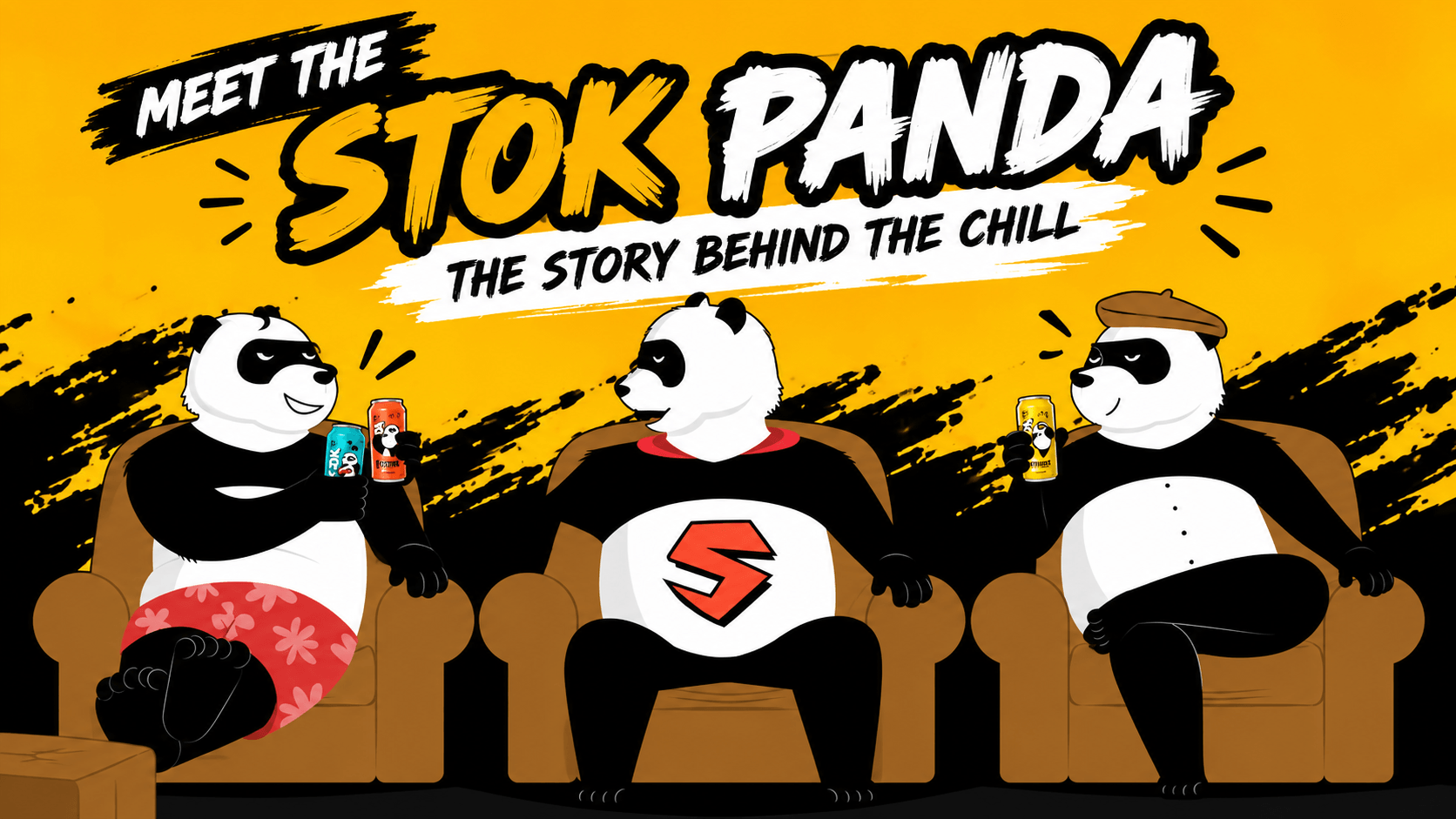
- STOK does not run one panda. It runs three, one for each beer in the range: Lager, Strong and Wheat.
- Each panda has its own personality, from the off duty lager lover to the daredevil who fronts the 8% strong beer.
- The character exists because chill is a feeling, not a claim. A panda shows it faster than any line of copy.
- Brand characters work hard. Analysis of IPA effectiveness data by System1 found campaigns built on a recurring character were 37% more likely to grow market share.
- In India, where beer brands face tight advertising limits, an owned character does work that paid media is not allowed to do.
Most beer brands in India sell you a moment. A last over finish, a beach in Goa, a Friday night that looks better than your actual Friday night. STOK does something else. It hands you a panda.
Look at the can. Look at the website. Scroll to the footer of almost any page on the STOK site and the same black and white character turns up, sitting, floating, breaking bamboo, or doing nothing at all. That last one is the whole point.
Here is why a panda ended up fronting an Indian craft beer brand, what the three STOK pandas stand for, and why a cartoon bear is doing serious commercial work in a category that cannot advertise like everyone else.
Who is the STOK Panda?
The STOK Panda is the brand mascot of STOK beer, made by Mount Everest Breweries Limited. It appears on packaging, across the STOK website, at brand events and on social channels, and it carries one idea: #LiveTheChill.
STOK treats the panda as a cast, not a logo with ears. The brand introduces three carefree pandas as the heartbeat of the brand, and each one belongs to a beer. So the honest answer to who the STOK Panda is is a family of three, not a single character.
The brand is brewed in Indore by MEBL, a company that has been building beer culture in central India since 1999. You can read about the people behind STOK on the brand’s About Us page, including the master brewer and the family that runs the business.
Why a panda and not something louder?
Beer branding in this market leans hard on strength. Lions, eagles, kings, thunder, roars. STOK walked the other way, and the choice holds up for three reasons.
Pandas already mean calm
Nobody has to be taught what a panda stands for. Giant pandas can spend up to 12 hours a day eating bamboo, according to the Smithsonian’s National Zoo. Their day is eat, sit, rest, repeat. That cultural shorthand was already built and paid for by nature, so STOK inherited a meaning instead of spending years creating one.
The silhouette does the branding
Marketers judge a brand asset on two things: how many buyers link it to the brand, and whether it points to that brand alone. A panda scores on both. Black, white, round, readable at thumbnail size on a phone and from across a dim bar. Blur the can and you still know whose it is.
It has range
A lion cannot look sleepy. A panda can sit, nap, break bamboo, take a selfie, float through space and stay on brand every time. That range matters when one character has to hold up on a 330 ml bottle, a ten-second video, a poster at a house party and a website footer.
Three pandas, three moods
The cast splits cleanly across the range, and each panda doubles as a product guide.
- Lager than life. Fronts STOK Lager, a mild lager at 4.8% ABV. The unbothered one. Beaches, cool vibes, the end of a long day. Its own line on the page sums it up: not a lazy panda, just off duty.
- The Chill Keeper. Fronts STOK Strong, an American-style beer at 8% ABV. Picks up random dares, collects stories, does not lose sleep over comments and shares. Bolder beer, bolder character.
- The Wheat Lover. Fronts STOK Wheat, an American-style wheat beer at 4.7% ABV. The connoisseur of the group. Slower, smoother, more interested in the craft than the crowd.
One brand voice, three moods. Someone picking a beer is really picking a version of their evening, and the pandas turn that into a look rather than a spec sheet. If you want the full side-by-side, the Journal already breaks down which STOK variant fits your vibe.
Why a mascot carries more weight in Indian beer
India restricts the advertising of alcohol. The Cable Television Networks Rules bar direct and indirect promotion of liquor on television, and the CCPA’s Guidelines for Prevention of Misleading Advertisements and Endorsements, 2022 gave surrogate advertising its first formal definition in Indian law. ASCI tightened its brand extension criteria in December 2023 on top of that. A useful summary of how alcohol advertising is regulated in India is worth a read if you work in the category.
Take mass advertising off the table and what is left? Packaging, shelf presence, events, owned channels and the brand’s own characters, colours and lines. Those assets become the main memory triggers, so they have to pull far more weight than they would for a soft drink.
The effectiveness data supports the approach. Using IPA effectiveness records, System found that campaigns built on a recurring brand character were 37% more likely to grow market share and 30% more likely to grow profit than campaigns without one. In System1’s Super Bowl analysis, character-led ads averaged a 3.7-star rating against 2.8 for ads led by famous faces.
A panda on a can is not a cute decision. It is a memory device that keeps working in places a media buy cannot reach.
Five jobs the panda does that a logo cannot
- It names the feeling. Chill is abstract. A panda lying flat is not.
- It sorts the range. Three characters do the work of a product comparison chart without reading like one.
- It travels across formats. Sticker, GIF, bottle, banner, coaster, reel. The character survives every crop.
- It ages slowly. A celebrity face changes contracts and headlines. A brand owned character stays put for a decade if you let it.
- It keeps tone consistent. Every team that touches the brand has one easy test: would the panda do this?
What Live the Chill says about the 2026 beer drinker
The market context explains the positioning. IMARC values India’s beer market at INR 477.05 billion in 2025, with growth forecast at a 6.45% CAGR through 2034. Premium and craft options are taking a bigger share of that, and drinking occasions keep moving from the bar to the house party.
MEBL has been moving with that shift. In September 2025 the company acquired Mysuru-based Cheers Breweries for around INR 300 crore, lifting installed capacity from 2 million to 3.5 million hectolitres and opening a southern hub. Reported plans include reaching 20 states and close to 8% of the national beer market by 2030.
Behind those numbers sits a plain consumer truth. Younger drinkers in metros and tier 2 cities are not short of stimulation. They are short of downtime. A brand selling calm instead of hype is reading the room correctly.
That is the job the panda was hired for. It says the quiet part first. The Journal goes deeper into the Only the Chilled mindset and how it lands with young India.
Where you will run into the panda
- On packaging, across bottles and cans in the Lager, Strong and Wheat range.
- On the product pages, where each panda gets its own scene, verse and animation.
- At brand activations and house party formats listed on the STOK events
- In the STOK Journal, where the same voice runs through posts on beer culture, party planning and craft beer terms.
- On Instagram and YouTube, where short form video suits a wordless character better than most brand assets.
STOK Panda vs standard beer mascot thinking
- Status versus ease: Most beer branding sells arrival. The panda sells permission to stop.
- One character versus a cast: A single mascot builds recall. Three build recall and help people choose.
- Ad led versus asset led: Characters built for television struggle when television is closed to you. This one lives on the pack.
- Loud versus quiet: Volume is the most copied tactic in the category, which makes calm the cheaper way to stand out.
If you are planning a gathering rather than studying brand strategy, the practical version of all this sits in the guide to the best beer for a party in India.
Frequently asked questions
What is the STOK Panda?
The STOK Panda is the mascot of STOK beer, a craft beer brand from Mount Everest Breweries Limited. It appears on packaging, the website, brand events and social media, and represents the brand idea of Live the Chill.
Why does STOK use a panda as its mascot?
A panda communicates calm without explanation. It is instantly recognisable, it works at any size, and it can be posed in dozens of ways while staying on brand. For a beer brand built on chill rather than strength, it is a natural fit.
How many STOK pandas are there?
Three. One for each variant. The laid-back panda fronts STOK Lager at 4.8% ABV, the daredevil fronts STOK Strong at 8% ABV, and the connoisseur fronts STOK Wheat at 4.7% ABV.
What does #LiveTheChill mean?
It is the STOK brand philosophy. The short version: life is better lived unhurried, and a beer is an excuse to slow down rather than speed up. The panda is the visual form of that idea.
Who makes STOK beer?
Mount Everest Breweries Limited, part of the Associated Kedia Group, brews STOK at its Indore facility in Madhya Pradesh. The company also operates a brewery in Mysuru, Karnataka, acquired in 2025.
The story behind the chill
STOK could have sold power. The shelf was already full of it. The brand picked an animal that does almost nothing and is loved for exactly that, then built three personalities around it so the mascot works as a range guide too.
That is the story behind the chill. The panda is not decoration. It is the shortest way the brand has of saying what the beer is for, and it keeps saying it long after any campaign ends.