
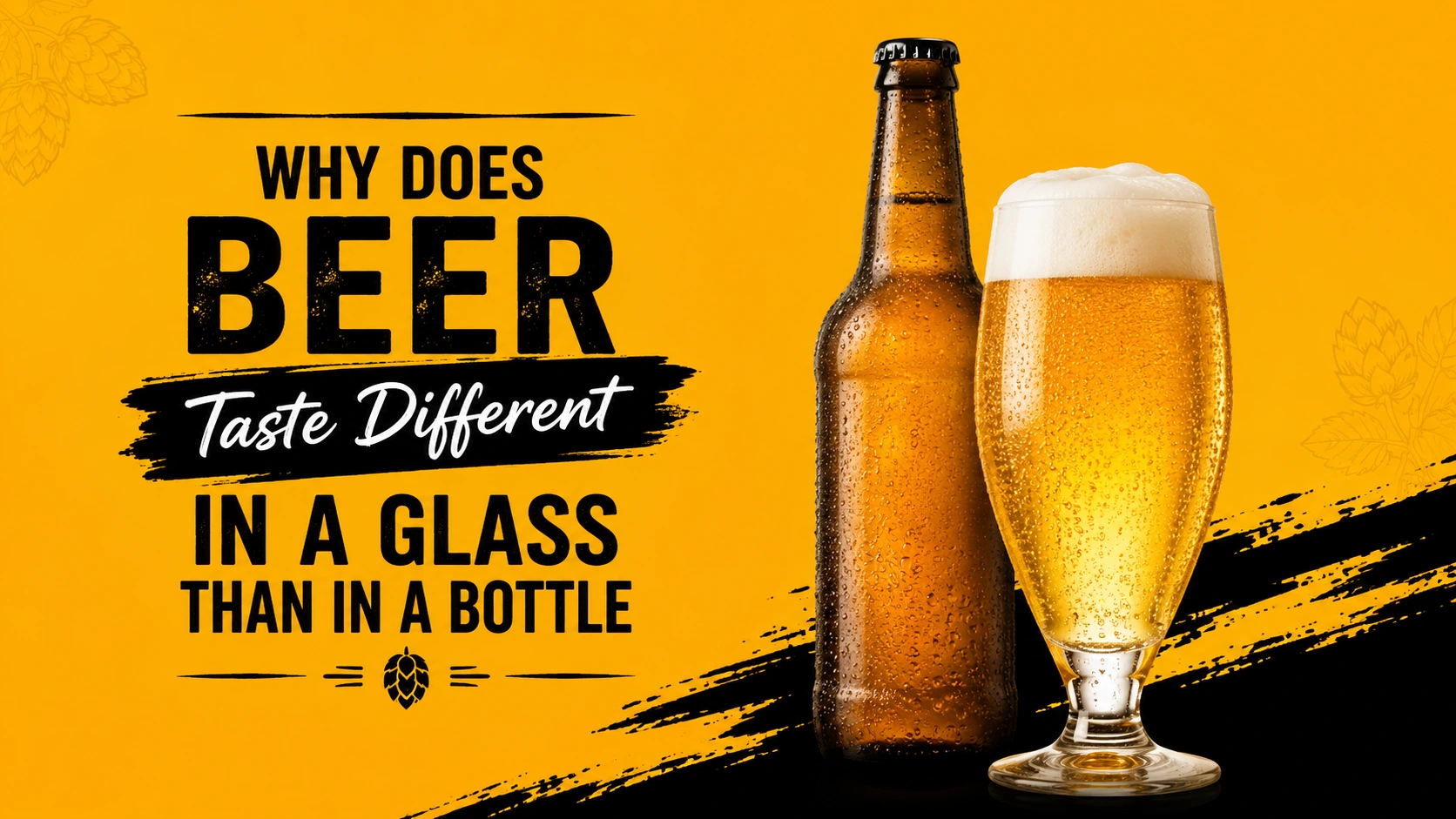
You have probably had this argument at a house party. Someone pours their lager into a glass, someone else keeps swigging straight from the bottle, and a third person insists it makes no difference at all.
It does make a difference. And it isn’t snobbery; it’s chemistry, physics and a bit of psychology working together. The beer is identical. What changes is how much of it actually reaches your senses.
Here’s what’s really going on, and what it means for how you drink beer in an Indian summer.
Why Beer Tastes Better in a Glass Than a Bottle
Beer tastes different in a glass because most of what we call “taste” is actually smell. A bottleneck traps aroma compounds and keeps your nose away from the liquid, so you perceive mainly bitterness, sweetness and carbonation. A glass releases those volatile compounds, builds a foam head that carries aroma upward, and lets your nose do roughly two-thirds of the tasting.
Four things drive the difference:
- Aroma access: A glass exposes surface area; a bottle neck doesn’t.
- Foam: The head concentrates and delivers aromatic compounds.
- Carbonation release: Pouring knocks out excess CO₂, softening the fizzy bite.
- Temperature and sight: A glass warms the beer slightly and lets you see it, both of which shift perception.
Now the details.
Most of beer’s flavour is smell, not taste
Your tongue is a fairly blunt instrument. It handles sweet, sour, salty, bitter and umami. That’s it.
Everything else the banana note in a wheat beer, the bready malt in a lager, the citrus lift from hops arrives through your nose. Sensory scientists split this into two pathways: orthonasal olfaction (sniffing directly) and retronasal olfaction (aroma travelling up the back of your throat while you drink). New to terms like these? Our craft beer jargon guide breaks down the vocabulary bartenders throw around.
Beer sensory research is consistent on this point: aroma compounds need warmth and agitation to become airborne before your olfactory receptors can register them. Try it yourself: pinch your nose while sipping a beer and it collapses into “cold, bitter, fizzy”. Unpinch and the flavour floods back.
Drinking from a bottle blocks the orthonasal pathway almost entirely. The opening is narrow, your nose sits above the glass neck rather than over the liquid, and the aroma compounds that escape do so through a tiny gap. You still get retronasal aroma once the beer is in your mouth, which is why bottled beer isn’t flavourless, but you lose the first half of the experience completely.
A glass gives you both.
The foam head is doing real work
Indian drinkers often treat foam as waste. Pour carefully, minimise the head and get more beer in the glass. Understandable; nobody wants to pay for froth.
But foam isn’t packaging. Its function.
The head forms when CO₂ comes out of solution and gets stabilised by proteins and hop compounds from the malt and hops. As bubbles rise and burst, they carry volatile aroma molecules with them and release them right under your nose. Beer educators describe aroma compounds as tiny balloons that escape the liquid and pop at nose level.
Foam also does three other jobs:
- Traps the aroma so it doesn’t dissipate all at once
- Forms a barrier that slows oxidation on the surface
- Changes mouthfeel a creamy head softens the texture of the first sip
A two-finger head on a wheat beer isn’t the bartender cheating you. It’s the beer working properly.
Carbonation and the Smoother Sip: What Pouring Actually Changes
Beer in a sealed bottle is under pressure, holding far more dissolved CO₂ than it will keep once opened. Drink straight from the bottle and much of that gas ends up in your stomach rather than your nose.
Pour it, and the CO₂ has somewhere to go. Bubbles form at nucleation sites, microscopic imperfections and residues on the glass surface rise, and release aroma along the way. What’s left in the liquid is a softer, rounder carbonation instead of a sharp prickle.
This is also why a genuinely clean glass matters. Oil, lipstick, detergent film, or leftover chips masala on the rim will kill a head within seconds. Bartenders call a properly washed glass “beer clean” rinse with cold water before pouring and skip the tea towel.
Light and the skunky bottle problem
This one is bottle-specific, and it’s the strongest argument in the whole debate.
Hop-derived bitter compounds called isohumulones are light-sensitive. Expose them to light in the 350–500 nm range the blue end of the visible spectrum, plus UV with riboflavin (vitamin B2) acting as a photosensitiser, and they break down into 3-methyl-2-butene-1-thiol (MBT). That compound smells like skunk spray.
According to the Oxford Companion to Beer, MBT is one of the most flavour-active substances known, and the effect was first documented back in 1875. Peer-reviewed work in the Journal of Agricultural and Food Chemistry confirms the riboflavin-driven mechanism, with sensory thresholds measured in nanograms per litre. That’s a few parts per trillion.
What this means in practice:
| Container | Light protection | Skunking risk |
| Clear/flint bottle | Almost none | Very high |
| Green bottle | Partial | High |
| Brown bottle | Good | Low |
| Can | Total | None |
This is why brown glass is the industry default and why cans have won on quality grounds, not just cost. A beer sitting under fluorescent tube lights in a wine shop for a week is exposed the entire time. In a can, it isn’t.
So the honest version of the question is: the glass doesn’t only reveal what the beer has, it also reveals what the bottle may have taken away.
Temperature and the Indian Summer: Getting the Pour Right
Serve any beer at 2°C and you numb your palate. Bitterness drops, aroma compounds stay locked in solution, and everything tastes roughly like cold. This is exactly why very cold beer is forgiving of flaws.
Pour into a glass and the beer warms by a couple of degrees over the first few minutes. Aromatics wake up. Malt sweetness shows. That’s the beer you’re actually meant to be drinking.
In India, this cuts both ways. In Delhi or Chennai in May, a glass of beer left on a table will overshoot the ideal window fast. Come monsoon, the equation shifts again; here’s why STOK works differently once the rains set in. Practical approach: keep the bottle or can chilled, pour in smaller measures, and let each pour open up in the glass rather than let the whole beer die in the heat.
Rough serving guide:
- Lager: 4–7°C
- Strong lager: 5–8°C
- Wheat beer: 4–7°C, never straight from the freezer
Glass vs Bottle vs Can: What Actually Changes in Your Beer
| Factor | Straight from the bottle | Poured into a glass |
| Orthonasal aroma | Mostly blocked | Full access |
| Foam head | None | Forms and carries aroma |
| Carbonation feel | Sharp, gassy | Softer, integrated |
| Temperature control | Stays cold longer | Warms into its aroma range |
| Visual appeal | Hidden | Colour, clarity, head |
| Convenience | High | Lower |
Two honest caveats. First, the glass wins on flavour, not on practicality at a beach shack or a music festival, a bottle or can is the sensible choice. Second, glass shape matters less than most marketing suggests. A narrower opening relative to the bowl concentrates aroma toward your nose; a wide straight-sided pint glass lets it escape. But almost any clean glass beats no glass at all.
Does this actually matter to Indian drinkers in 2026?
More than it used to.
India’s beer market has shifted decisively toward premium and craft. Industry analysis puts the market at roughly ₹477 billion in 2025, growing at about 6.45% annually with premiumisation as the primary value driver. Standard lager still holds around half the market, but the growth is happening at the top brewpubs, canned craft, wheat variants, and lower-ABV options.
Cans have become the dominant packaging format, helped by portability, recyclability and, relevantly here, total light protection. Meanwhile, brewpub culture in Bengaluru, Gurugram, Pune and Mumbai has trained a generation of drinkers to expect their beer in glassware with a head on it.
The upshot: when a beer is brewed to be tasted rather than just consumed cold, the vessel stops being a detail. Brands like STOK Beer brewed by Mount Everest Breweries build flavour into each variant deliberately, and pouring is what lets you find it.
How to pour beer properly (30 seconds, no skill required)
- Rinse the glass with cold water. Don’t dry it with a cloth.
- Tilt to 45° and pour onto the inside wall, aiming for the middle.
- Straighten up when the glass is about two-thirds full.
- Pour down the centre to build a head of roughly 2–3 cm.
- Wait 30 seconds. Smell it before you drink it.
That last step is the one everyone skips, and it’s the one that matters most.
Try it yourself
The cleanest test takes one bottle. Pour half into a glass and leave half in the bottle. Sip from the bottle, then from the glass. Same liquid, same temperature, same minute.
Most people notice the difference immediately and can’t unnotice it afterwards. Run it with a STOK Wheat if you have one, since wheat beers carry strong banana-and-clove ester notes that a bottleneck hides almost completely. A STOK Lager shows the carbonation difference most clearly, and STOK Strong shows how much malt character a glass unlocks.
FAQ
Does beer really taste better in a glass, or is it psychological?
Both, and the physical effects come first. Aroma release, foam formation and CO₂ escape are measurable. Visual appeal adds to the experience on top of that, but even a blindfolded drinker will notice the aroma difference.
Why does beer taste skunky sometimes?
Light exposure. UV and blue light convert hop isohumulones into MBT, a sulphur compound detectable at parts-per-trillion levels. Clear and green bottles are most vulnerable; brown bottles are better; cans are immune.
Is canned beer worse than bottled beer?
No. Modern cans are internally lined so the beer never touches metal, and they block light completely. Any metallic taste people report usually comes from smelling the can rim while drinking. Pour it into a glass and it disappears.
What’s the right temperature for beer in India?
Around 4–7°C for lagers and wheat beers. Colder than that mutes flavour; warmer than about 10°C in Indian summer heat makes it flabby. Chill the container; pour in smaller measures.
Should I always pour with a big head?
Aim for 2–3 cm. Too little and you lose aroma delivery; too much and you’re waiting around. Wheat beers hold a bigger head naturally and benefit from it.
The takeaway
Nobody needs to abandon the bottle. There’s a time and place for drinking straight from one, and it usually involves a beach, a bonfire or not owning enough glassware.
But if you have ever wondered whether you’re actually getting what the brewer intended, you probably aren’t, unless you’re pouring. The beer doesn’t change. Your access to it does.
Next cold one, pour it out. Smell it first. Then decide.