
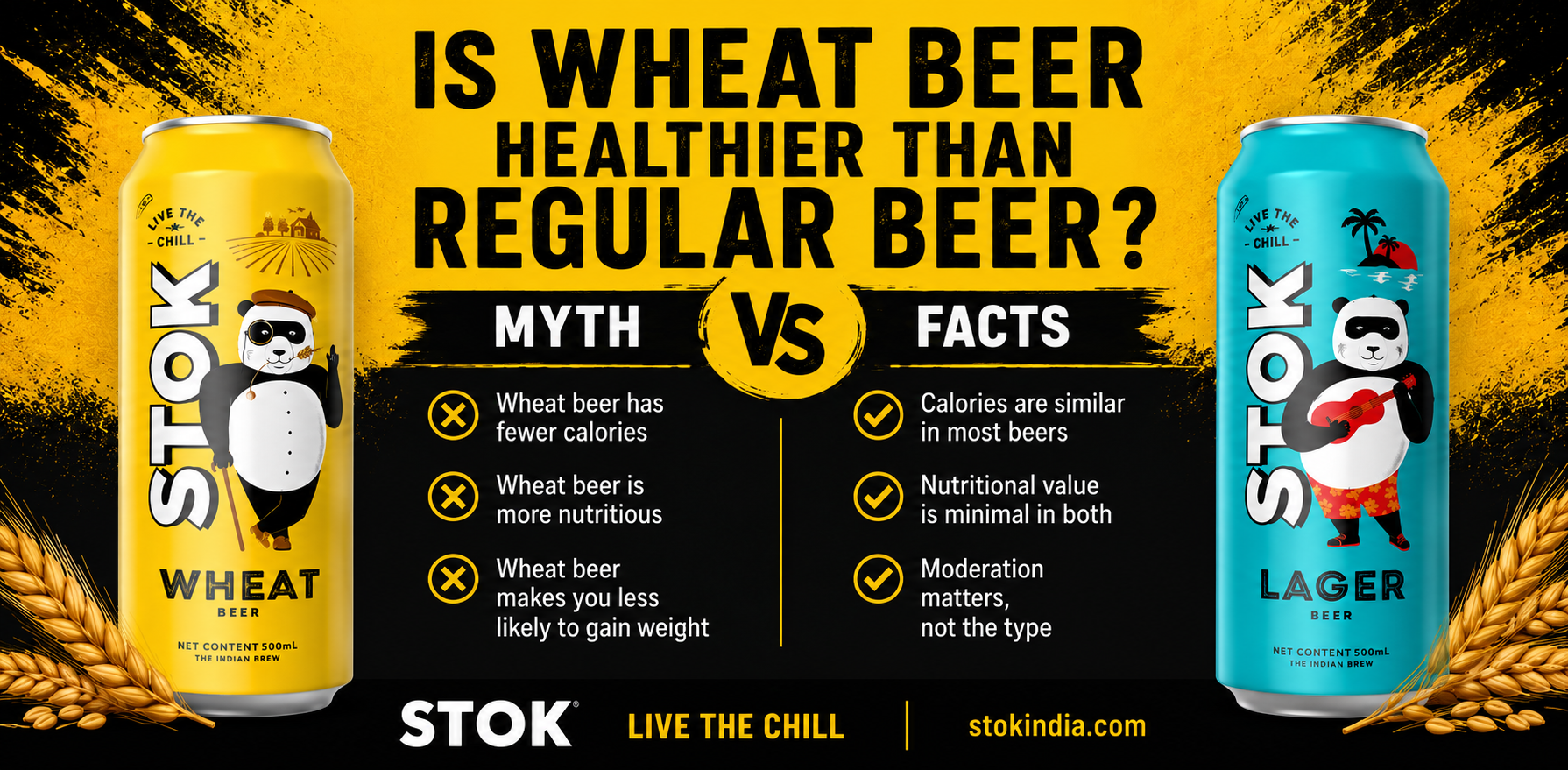
Quick Summary
Wheat beer is not meaningfully healthier than regular beer. Both get most of their calories from alcohol, not from grain. A wheat beer carries slightly more carbohydrate, a little more gluten, and a marginally different mix of B vitamins and polyphenols. Those gaps are small. What actually decides the health impact is how much alcohol you drink and how often not whether the mash bill leaned on wheat or barley.
Walk into any pub in Bengaluru, Gurugram or Pune and you’ll hear some version of it. Wheat beer is lighter. It’s healthier. It’s basically a smoothie with alcohol. The cloudy pour and the banana-clove aroma do a lot of persuasive work.
The claim deserves a proper look because it is half-true in a way that misleads people. Wheat beer is different from a standard lager. Different is not the same as better for you. Here’s what the evidence actually supports, and where the folklore takes over.
What counts as a wheat beer?
A wheat beer is brewed with a large proportion of malted wheat alongside barley usually somewhere between 30% and 60% of the grain bill. That wheat, plus a specific yeast strain, is what produces the haze, the soft mouthfeel and the fruity, slightly spicy aroma. If terms like mash bill or yeast strain are new to you, our craft beer jargon guide breaks down the vocabulary in plain language.
The category splits into a few recognisable families:
- Hefeweizen — The German original. Unfiltered, yeasty, strong banana and clove notes.
- Witbier — Belgian, brewed with unmalted wheat plus coriander and orange peel.
- American wheat — Cleaner and less yeast-driven, with the wheat character in the foreground rather than the esters. STOK Wheat sits here at 4.7% ABV.
- Berliner Weisse and gose — Sour, low-alcohol, still niche in India.
What does “regular beer” mean in India
For most Indian drinkers, regular beer means lager. That’s not a guess; lager accounts for the overwhelming majority of beer volume sold in the country, with standard lager alone holding roughly half the market. Strong beer at 7–8% ABV takes a large slice of that, driven by a value-per-rupee calculation that has shaped Indian drinking for decades.
So the real comparison most people are making is: wheat beer versus my usual lager or strong beer. That framing matters, and we’ll come back to it.
Wheat beer vs regular beer: the actual numbers
| Factor | Wheat beer (~4.7–5% ABV) | Standard lager (~4.5–5% ABV) | Strong beer (~7–8% ABV) |
| Calories per 330 ml | ~140–160 kcal | ~135–150 kcal | ~200–230 kcal |
| Carbohydrates per 330 ml | ~11–14 g | ~10–13 g | ~14–18 g |
| Main calorie source | Alcohol | Alcohol | Alcohol |
| Non-starch polysaccharides | Higher | Lower | Lower |
| Gluten | Higher | Moderate | Moderate |
| B vitamins | Trace | Trace | Trace |
| Polyphenols | Present, hop-dependent | Present, hop-dependent | Present |
Read that table and the picture is clear. The wheat column is not a health column. It’s a slightly different column.
Calories: alcohol does the damage, not the grain
Ethanol delivers about 7 kcal per gram. That is nearly as dense as fat and roughly double what carbohydrate gives you. In a 5% beer, alcohol supplies the bulk of the calories before you count a single gram of residual sugar.
Which leads to the single most useful rule in this whole debate: ABV predicts calories better than beer style does. A 4.7% wheat beer will almost always be lighter than a 7.5% strong lager. A 4.7% wheat beer versus a 4.7% lager? Nearly identical, give or take a few calories.
Carbohydrates and fibre
Wheat beers do carry more non-starch polysaccharides, arabinoxylans, beta-glucans, and mannose polymers because wheat malt contributes more of them. A comparative study published in Foods measured 1,953–2,923 mg/L in wheat beers against 1,442–1,756 mg/L in barley malt beers.
This is where the “beer has fibre” line comes from. It’s technically accurate and practically irrelevant. Roughly a gram per bottle isn’t a fibre source. A bowl of dal will do more for you before you finish reading this paragraph.
B vitamins and minerals
Beer contains small amounts of riboflavin, niacin, folate, magnesium and potassium — all inherited from the cereal. Wheat beers are often unfiltered, so more yeast stays in suspension, and yeast is where a chunk of those B vitamins live. That’s a real difference.
It’s also a small one. You’d have to drink an unhealthy volume to make beer a serious contributor to your daily B-vitamin intake, at which point the alcohol has comprehensively outweighed the vitamins.
Polyphenols and antioxidants
Beer does contain polyphenols from barley and hops, and there’s genuine research interest in them. But hop load drives polyphenol content more than wheat content does, which is why a heavily hopped IPA typically outscores both a hefeweizen and a pilsner. Wheat beers tend to be lightly hopped by design. The style is not an antioxidant leader.
Gluten
Here’s the one place where wheat beer is objectively worse for a specific group. Wheat beers contain more gluten than barley-based lagers, not less. Anyone with coeliac disease or a diagnosed wheat sensitivity should avoid them and look for certified gluten-free or gluten-reduced options instead.
If you’ve been ordering wheat beer because it “sounds lighter on the stomach,” that instinct is about carbonation and bitterness, not gluten.
Four myths, checked
Myth 1: Wheat beer is lower in calories. False. It’s typically the same or marginally higher than a lager of matching strength. The perception comes from wheat beers usually being sold at moderate ABV, while strong beer dominates Indian shelves.
Myth 2: Wheat beer is gluten-free or low-gluten. False, and worth correcting. It’s the opposite.
Myth 3: Wheat beer is a health drink because of vitamins and fibre. Overstated to the point of being wrong. The quantities are trace. No credible nutrition body classifies any alcoholic beer as a health food.
Myth 4: Cloudy means natural means healthy. The haze is suspended yeast and wheat protein. It’s a stylistic and flavour outcome, not a nutrition signal.
What health authorities actually say
This is the part most beer content skips, so let’s be direct.
The World Health Organization has stated that no level of alcohol consumption is safe for health, and classifies alcohol as a Group 1 carcinogen. The ICMR-National Institute of Nutrition’s Dietary Guidelines for Indians (2024) advise avoiding alcohol altogether as part of a healthy diet.
No beer style escapes that. Not wheat. Not craft. Not “premium.” The honest framing for anyone who chooses to drink is risk reduction, not health benefit and that means lower ABV, smaller volume, fewer occasions, and food alongside.
Any brand telling you otherwise is selling, not informing.
Where wheat beer genuinely has an edge
Not everything about the wheat beer reputation is invented. Three things hold up:
- Moderate ABV by convention: Most wheat beers land between 4.5% and 5.5%. If you’re switching from an 8% strong beer, you’re cutting alcohol per serve by roughly 40%, a real reduction, and the only meaningful “healthier” claim in this entire discussion. This maps directly onto STOK’s own lineup: moving from STOK Strong (8% ABV) to STOK Wheat (4.7% ABV) is close to that same 40% cut in alcohol per serve, without trading down to a thin or flavourless beer.
- Slower drinking: Wheat beers are aromatic and full-bodied. People sip them. They chug light lagers. Pace matters more than most drinkers admit.
- Lower bitterness: Less hop bitterness makes the style easier to pair with food, and eating while drinking slows alcohol absorption.
Notice that none of these are about wheat. They’re about strength, pace and context. Wheat beer is a proxy for better drinking habits, not a cause of them.
How India is actually drinking in 2026
The market context explains why this question keeps coming up now.
India’s beer market was valued at roughly ₹477 billion in 2025 and is projected to reach around ₹833 billion by 2034 — a CAGR of nearly 6.45%. But volume isn’t the story. Premium and craft, though still a small share by volume, now drive close to half of incremental growth, expanding at over 20% annually against 4–6% for traditional styles.
Wheat beers and premium lagers are showing up more in urban retail and hospitality, particularly across Maharashtra, Karnataka, Telangana and Delhi NCR. Alongside that, low-alcohol and non-alcoholic launches have multiplied — Ironhill’s non-alcoholic wheat beer in late 2025 being one example of brewers reading the moderation trend directly.
Per capita beer consumption in India sits around 2.15 litres, against an Asia-Pacific average near 15.33 litres. The Indian drinker isn’t drinking more. They’re increasingly choosing better, a shift we unpack in why STOK Beer connects with young India, and it’s exactly why “is this one healthier?” has become a purchase question rather than a trivia question.
That’s the shift STOK Beer was built around, with Lager, Strong and Wheat sitting side by side so the choice is about mood and occasion rather than marketing.
A sensible way to choose
- Watching calories? Read ABV first. Ignore the style name.
- Coeliac or wheat-sensitive? Skip wheat beer entirely.
- Cutting back? Moving from strong beer to a 4.7% wheat or lager is a genuine, measurable step down.
- Diabetic or managing blood sugar? Talk to your doctor. Alcohol interacts with glucose control in ways no beer style fixes.
- Any beer at all? Serving size and frequency beat every other variable combined.
Frequently asked questions
Is wheat beer good for weight loss?
No. A 330 ml wheat beer carries roughly 140–160 calories, most of it from alcohol, and alcohol also suppresses fat oxidation while it’s being metabolised. No beer supports weight loss. Lower-ABV beers simply cost you less.
Does wheat beer have less alcohol than regular beer?
Usually, yes, but by convention, not by rule. Most wheat beers run 4.5–5.5% ABV, while Indian strong beers hit 7–8%. Wheat beers can be brewed strong, too. Check the label.
Is wheat beer safe for people with gluten intolerance?
No. Wheat beers contain more gluten than barley lagers. Anyone with coeliac disease should choose certified gluten-free beer instead.
Which is better for the stomach, wheat beer or lager?
There’s no clinical evidence either way. Some drinkers find wheat beer’s lower bitterness and softer carbonation easier, but that’s individual tolerance, not a physiological advantage.
Does wheat beer contain probiotics?
Rarely. The live yeast in unfiltered wheat beer isn’t a probiotic strain, and alcohol is hostile to gut bacteria regardless. Treat that claim as marketing.
The bottom line
Wheat beer is a distinct style with a real character, cloudy, aromatic, soft, usually moderate in strength. That’s worth choosing it for. It is not a health product, and no honest brewer will tell you it is.
If you drink, drink less and drink slower. Read the ABV. Eat something. And pick the beer you actually want, for the reason you actually want it, whether that’s what to reach for during the monsoon or any other evening, not because a rumour told you it was virtuous.