
Quick summary
In India, the split between strong and mild beer is a legal line, not a taste opinion. FSSAI sets mild (regular) beer at more than 0.5% and up to 5.0% ABV, and strong beer at more than 5.0% and up to 8.0% ABV. Above 5%, the label reads strong. Strong beer carries more alcohol per sip, a fuller body, and more residual sweetness. Mild beer is lighter and easier to drink over a long evening. Pick by occasion, not by pride, and adjust your pace to the ABV. STOK brews both a Strong and a Lager for exactly that reason.
Ask ten people in Delhi what makes a beer strong, and most will say it tastes heavier or hits harder. They are half right. In India, the word strong is not a vibe. It is a legal classification tied to a single number: alcohol by volume, or ABV.
Once you understand where that line sits, the whole beer shelf makes more sense. You stop guessing and start reading. At STOK Beer India, we brew a Strong and a Lager, so this question comes up at every tasting. Here is the real difference.
What defines strong beer and mild beer in India?
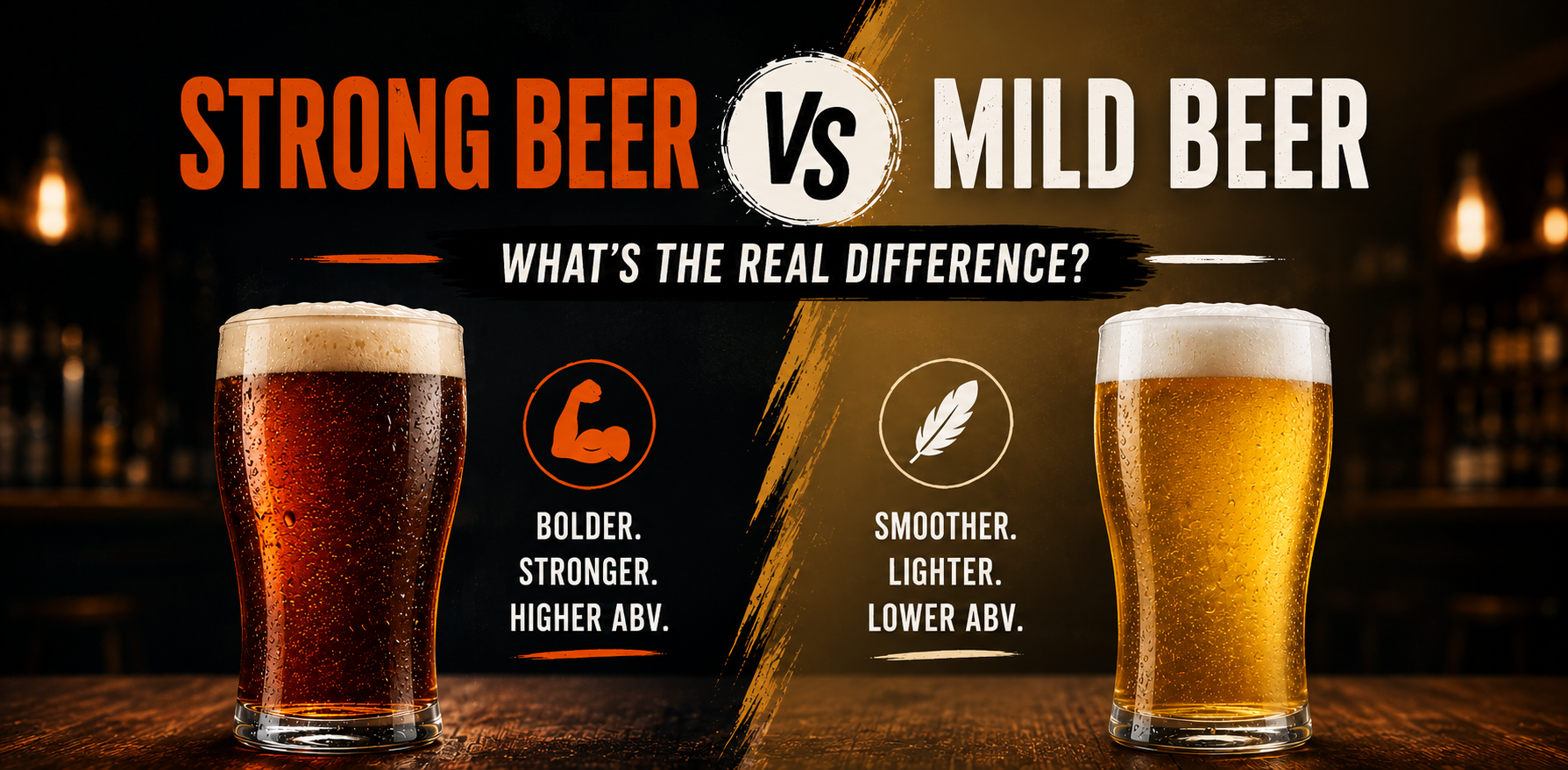
The Food Safety and Standards Authority of India (FSSAI) sets the rules. Under the Alcoholic Beverages Regulations, 2018, beer falls into clear bands by alcohol content:
- Regular or mild beer: More than 0.5% and up to 5.0% ABV.
- Strong beer: More than 5.0% and up to 8.0% ABV.
- Alcohol-free beer: 0.0% ABV, meeting the other requirements set for regular beer.
That is the whole basis of the label. A beer at 4.8% is mild. A beer at 6% is strong. The word tells you about alcohol content first, and only after that about how the beer might feel.
The 5% line that splits the shelf
Indian excise rules lean on the same threshold, which is why the shelf jumps straight from mild to strong with little in between. A 5% import can drink lighter than a 7% Indian strong beer, yet both sit on either side of one fixed line. When you read a label, treat the ABV number as the truth and the marketing words as decoration.
This is worth repeating because soft words hide hard numbers. Smooth, premium, light, and crisp do not tell you the alcohol content. A beer can taste light and still carry close to 5% ABV. Always check the figure printed on the can or bottle.
What changed for beer rules in 2026?
FSSAI notified the First Amendment to these regulations, effective from 1 January 2026. Among other updates, it added a defined column for craft beer strong, covering more than 5.0% and up to 8.0% ABV, and refined a few technical requirements around carbonation. The core mild and strong bands stayed the same, so the 5% line still governs how your beer gets labelled.
Does strong beer taste different, or just contain more alcohol?
Both, though the alcohol comes first. To reach a higher ABV, brewers ferment more sugar. More malt in the recipe means more body and often more residual sweetness. So a strong beer tends to bring:
- A fuller, heavier mouthfeel.
- More malt-forward sweetness.
- A longer, warmer finish.
How much more alcohol is in a strong beer?
Put it in real numbers with the common 650 ml bottle:
- A 650 ml bottle at 5% ABV holds roughly 26 grams of pure alcohol.
- A 650 ml bottle at 8% ABV holds roughly 41 grams of pure alcohol.
This is not a reason to avoid strong beer. It is a reason to drink it knowingly: slower, in smaller quantities, and with food.
A useful test is to count in standard drinks, not bottles. Two friends can each finish one 650 ml bottle and take in very different amounts of alcohol, depending on whether the label reads 5% or 8%. The bottle looks the same. The maths does not. India also sets a low blood-alcohol limit for driving, so if you plan to drive, a strong beer leaves far less room than a mild one.
When should you pick mild over strong?
A simple frame helps here. Match the beer to the moment.
- Pick strong for smaller quantities, a fuller-flavour mood, and occasions with a proper meal on the table. Treat one strong bottle as more than one drink, because it is.
A few habits keep either choice enjoyable:
- Adjust serving size by ABV. If you would drink two mild bottles, one strong bottle is closer to the same alcohol load.
- Match pace to strength. A strong beer over 45 minutes delivers far more alcohol than a mild beer over the same time.
- Eat and hydrate, whatever the ABV. Food and water make every beer sit better.
Why do Indians drink so much strong beer?
India leans strong, and the numbers back it. Strong beer in the 5% to 8% range has long made up the large majority of beer sales in the country. Two forces drive this.
- Value per rupee. Excise and label fees fall on the bottle, not only on the alcohol inside it. A strong beer offers more alcohol for a similar price, so budget shelves fill up with strong options.
- Habit and taste. A large group of drinkers grew up on strong lagers and read them as the default. The full body and higher kick feel familiar.
Beer still has a small share of total alcohol in India, and high state taxes keep prices high. But within beer, strong has led for years. The mild and premium segments are growing now, as more drinkers pick flavour and sessionability over sheer strength.
How do you read an Indian beer label?
Once you know the ABV bands, a label stops being marketing and starts being data. Here is what to look for, in order.
- ABV first – Find the alcohol by volume figure. Up to 5.0% is mild; above 5.0% and up to 8.0% is strong. This one number sets your pace for the night.
- Ignore the mood words – Smooth, premium, crisp, and bold describe a feeling, not a strength. Two beers can share the word premium and still differ by three points of ABV.
- Check the pack size – A 650 ml bottle holds nearly twice as much beer as a 330 ml can. Strength and size together decide how much alcohol you take in, so read them as a pair.
- Note the statutory line – Every Indian label carries a health and drink-driving warning by law. It is a useful reminder, not fine print to skip.
Spend ten seconds on this and a beer will rarely surprise you. The label already tells you what the advertising works hard to soften.
Does price track strength in India?
Often it does, but not for the reason you might guess. State excise and yearly label fees land on each bottle, not only on the alcohol inside it. So a mild beer and a strong beer can carry a similar tax load, which pushes the value maths toward strong beer on budget shelves: more alcohol for close to the same price.
This is also why the same bottle can cost very different amounts across states, sometimes twice or three times as much, depending on local excise. When you compare beers, weigh flavour and occasion, not only alcohol per rupee. The cheapest route to more alcohol is rarely the best route to a good evening.
How STOK approaches strong and mild
The honest takeaway is this: strong and mild are not better or worse than each other. They are different tools. Knowing which one is in your hand is the first step to drinking well.
Both Strong and Lager use German hops and quality millets, brewed under a seasoned Indian master brewer as part of our brewing story. You can see the full STOK range here and choose the one that fits your plan for the night, not just your ego.
Key takeaways
- In India, strong and mild are legal categories set by ABV, not taste labels.
- FSSAI: mild is more than 0.5% up to 5.0% ABV; strong is more than 5.0% up to 8.0% ABV.
- The 5% line governs the label, so the shelf jumps from mild to strong with little in between.
- Strong beer carries more alcohol per sip, a fuller body, and more sweetness.
- Pick by occasion: mild for long, casual sessions; strong in smaller amounts with food.
Frequently asked questions
What is the ABV range for strong beer in India?
More than 5.0% and up to 8.0% ABV, as set by the FSSAI Alcoholic Beverages Regulations, 2018.
Is mild beer the same as light beer?
Not always. Mild is a legal band up to 5.0% ABV. Light is a marketing term that may point to fewer calories or a lighter taste. Read the ABV to be sure.
Does strong beer get you drunk faster?
It delivers more alcohol per sip, so yes, at the same pace and volume, it affects you faster. Slow down and eat when you drink strong beer.
Is strong beer worse for your health than mild beer?
The main difference is alcohol quantity, not the beer itself. More alcohol per bottle means you should drink fewer of them. All alcohol carries risk, so moderation is the point.




2 responses to “Strong Beer vs Mild Beer: What’s the Real Difference?”
[…] you want to understand the technical difference between the two, our guide to strong vs mild beer explains how ABV separates the […]
[…] you are still deciding which category fits your evening, our detailed breakdown on strong beer vs mild beer walks through the practical differences in more depth. Our guide to the best beer for a party in […]